Review · MUNICH
Superior E-Bike Tour incl. 3rd Reich Sites & a beer Garden Stop
History gets clearer on two wheels. This five-hour Munich e-bike tour links the city’s royal squares, Nazi-era sites, Jewish quarter, museums, and English Garden in one well-paced route. I like the small group of up to 14 people, which should make it easier to hear the guide and ask questions. I also like the chance to see far more than you could on foot, including places tied to Hitler’s early political career and the resistance to Nazi rule.
The serious subject is handled alongside ordinary Munich life: cyclists, cafés, grand public squares, and a stop at a traditional beer garden. The main drawback is that you need to be comfortable riding a bike, following traffic signals, and staying alert in city streets. The tour is not a passive sightseeing ride.
Key points to know before booking
- A five-hour route covers both famous sights and difficult history, from Hofbräuhaus and Marienplatz to Königsplatz and Feldherrnhalle.
- The English Garden gets about an hour, giving you a welcome change from city streets and time to see Munich’s famous urban park.
- The Third Reich focus is specific, covering the failed 1923 putsch, Nazi propaganda sites, resistance memorials, and the Jewish center at St-Jakobs-Platz.
- Guides such as Simon, Jack, Will, and Chris have received strong praise for clear explanations, good humor, and an upbeat approach to serious material.
- Food and drinks are not included, so bring money for the beer garden stop.
- The $93.92 price is reasonable if you want history and general sightseeing in one outing, but less appealing if you only want a casual bike ride.
Starting at Marienplatz with a short orientation
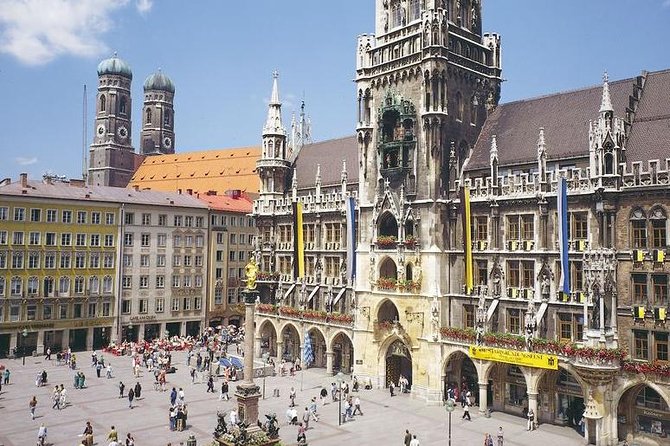
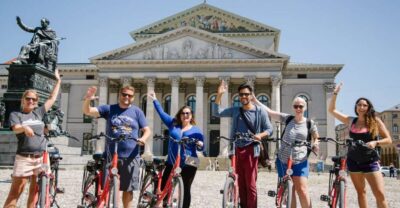
The tour begins at Marienplatz at 9:30 a.m., Munich’s central square and the natural place to begin a city tour. You do not cycle through the square. Instead, the guide gives you an overview on foot before leading the group to the bikes.
That opening matters. Marienplatz can feel like a swirl of pedestrians, historic buildings, shopping streets, and tour groups. A short orientation helps you place the city’s main sights before you start moving. You then receive a helmet and your bike before setting off at a leisurely pace.
The tour ends at a central location near Bräuhausstraße, at the Discover Bavaria shop operated by Mike’s Bike Tours. Hotel pickup and drop-off are not included, so plan to reach Marienplatz on your own and make your own way afterward.
More Beer Bike Tours in Germany
- Classic Mike’s Bike Tour daily @ 11.30 incl Beer Garden & Surfers
★ 5.0 · 1,246 reviews - Munich: Bike Tour with Beer Garden Break
★ 4.9 · 391 reviews - Munich City Bike Tour + Beer Garden Lunch Stop
★ 5.0 · 283 reviews
Odeonsplatz and the Feldherrnhalle: where the story turns dark
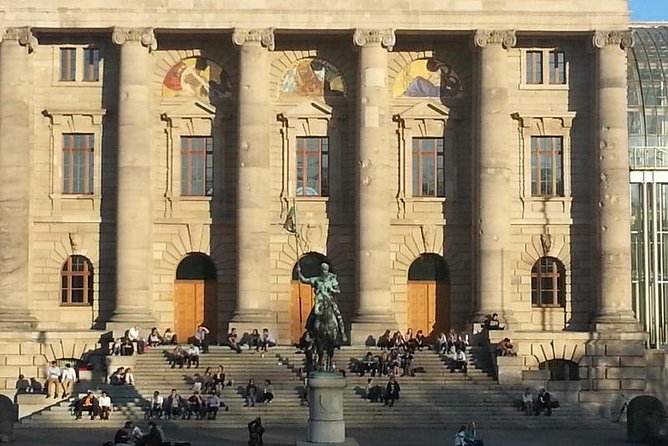
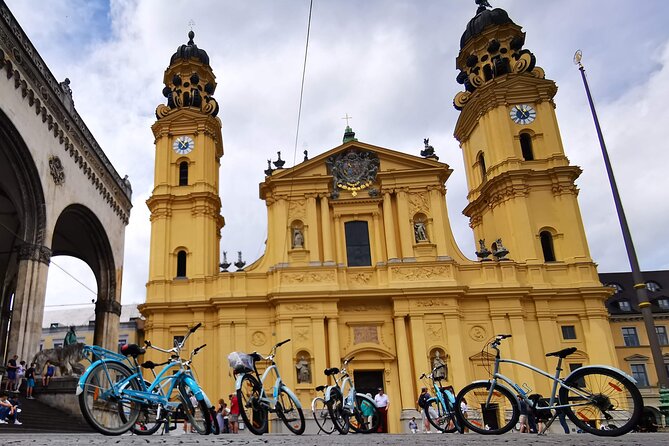
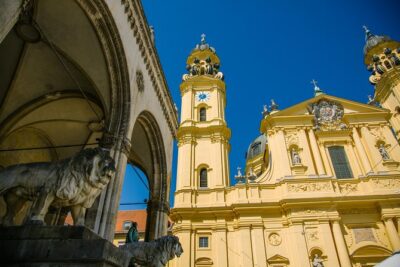
Odeonsplatz is one of Munich’s grandest public spaces. The Theatinerkirche, the Residenz, and the Feldherrnhalle give the square a polished royal appearance, but the Nazi-era story changes how you see it.
Your guide explains the 1923 Beer Hall Putsch, when Hitler and his supporters tried to seize power in Bavaria. The attempt failed after a confrontation with Bavarian police near the Feldherrnhalle. This was not yet the Nazi regime, but the event became an important part of Hitler’s political legend.
The Feldherrnhalle later became a Nazi shrine. Nazi symbols were added, SS guards were posted there, and people were expected to give the Nazi salute as they passed. After the war, those additions were removed. Today, the building looks like a classical monument again, but the site still carries the memory of how public places can be given new meaning by political power.
This is one of the strongest parts of the tour because you are not simply looking at a monument. You are learning how the same square changed from royal military symbol to Nazi propaganda site and then back into a public monument.
Max-Joseph-Platz and Munich’s royal center
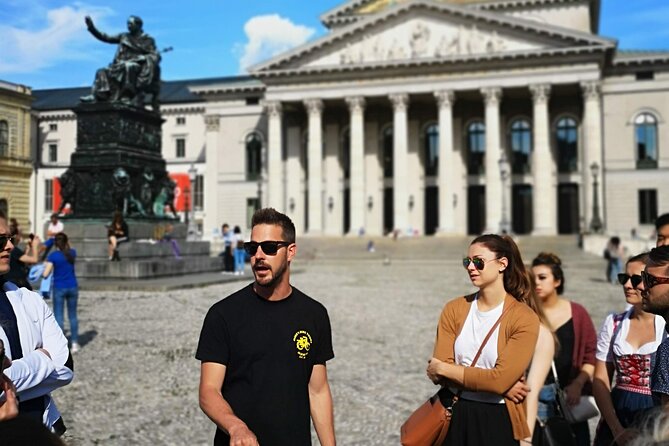
The route continues to Max-Joseph-Platz, named for King Maximilian I Joseph of Bavaria. The square is framed by the Residenz and the National Theatre, so it offers a quick look at Munich’s royal and cultural identity.
The Residenz was the former palace of Bavaria’s rulers. The National Theatre remains associated with opera and the performing arts. You will not tour either building during this bike excursion, but the stop gives your guide a useful chance to explain how Munich developed as a seat of royal power and culture.
This is also a good example of the tour’s broader design. It does not isolate Nazi history from everything else. Instead, you see the city’s royal past, cultural life, and twentieth-century dictatorship in the same route. That comparison gives the political story more context.
The stop lasts about 10 minutes, so expect an explanation and a look around, not an extended palace visit.
Königsplatz and the physical setting of Nazi propaganda
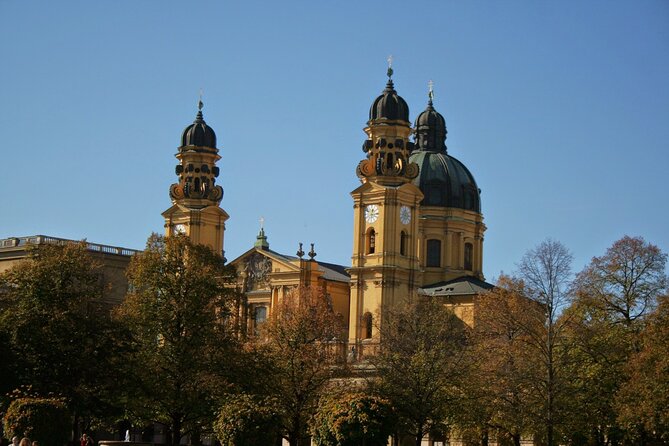
Königsplatz was designed in the nineteenth century with classical Greek architecture in mind. The Glyptothek and the State Collection of Antiquities give the square a museum-like character, and the open space feels designed for ceremony.
The Nazis used Königsplatz for rallies and propaganda events. The former Brown House, the Nazi Party headquarters, was nearby. Your guide connects the square to the wider Nazi presence in Munich and explains how a place built to celebrate classical culture was used for mass political theater.
Königsplatz is particularly effective on a bike tour because you can understand its scale. A short stop lets you see the buildings, open space, and surrounding streets without spending half a day inside a museum. The limitation is obvious too: you will not have time to explore the collections inside the museums.
After the war, the square was returned to public use. It now functions as a civic space and cultural area, but its earlier use remains part of the way you read it.
More Beer Bike Tours in Munich
- Mini Classic Bike Tour @ 4pm incl. Beer Garden & Surfers 2,5 hrs
★ 5.0 · 251 reviews - Munich: Mini Classic Bike Tour with Beer Garden Stop at 4 PM
★ 4.8 · 28 reviews - Private Munich Bike Tour: Flexible Times & Beer Garden Stop
★ 5.0 · 15 reviews - Private Highlights of Munich Bike Tour with Beer Garden Stop
★ 5.0 · 3 reviews
Schwabing and the city’s artistic side
Schwabing offers a change of tone. Once an independent village, it became associated with artists, writers, students, and intellectual life as Munich expanded. Names connected with the district include Wassily Kandinsky, Paul Klee, and Thomas Mann.
The stop helps prevent the tour from becoming a single-track account of Nazi politics. You see another side of Munich, one linked with art, literature, cafés, and counterculture. At the same time, the district’s later gentrification means you should not expect an untouched bohemian quarter. Today, Schwabing is known for nightlife, restaurants, shops, and student life.
This part of the ride is brief, about 15 minutes. Think of it as a neighborhood context stop rather than a full district tour.
The English Garden provides the tour’s breathing space
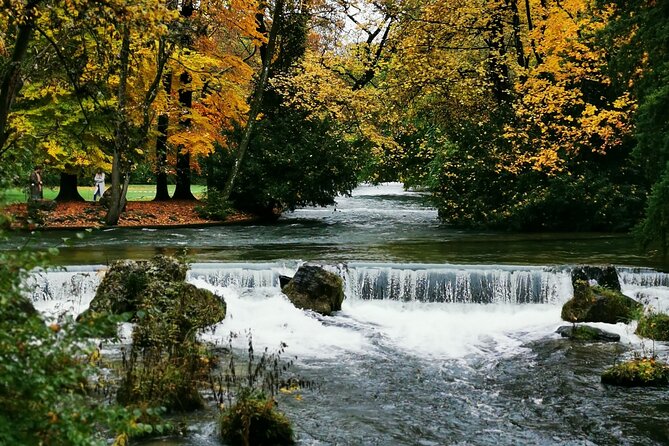
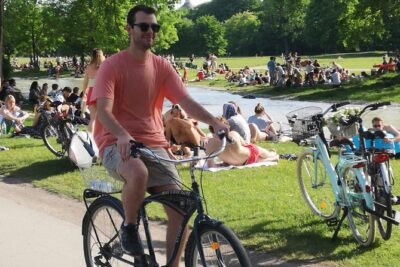
The English Garden is the route’s longest stop, with about an hour allocated to Munich’s huge city park. It is one of the world’s largest urban parks and larger than New York’s Central Park.
Here, the bike becomes especially useful. The park has paths, open meadows, beer gardens, and several well-known sights spread across a broad area. You may see the Chinese Tower, the Monopteros, and the Eisbach Wave, a famous place where surfers ride a standing wave in the middle of the city.
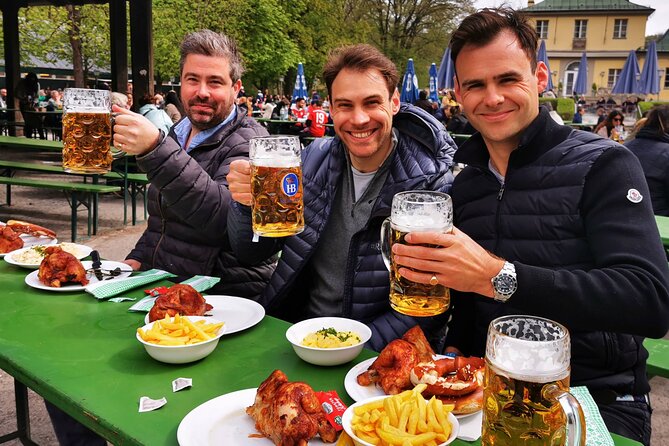
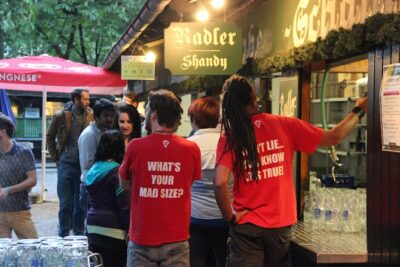
The park is also where the tour’s beer garden break fits naturally. Food and drinks cost extra, so carry funds for snacks or a drink. The stop gives you time to rest, take in the surroundings, and talk with the guide without standing in a crowded square.
I see this hour as an important part of the value. Five hours of serious history could feel heavy, especially for younger visitors or anyone traveling with mixed interests. The park adds fresh air and a more relaxed Munich experience.
One practical point: do not treat the beer garden stop as an included meal. The supplied information lists food and drinks as your own expense, and the tour does not promise a particular snack or beverage.
Haus der Kunst and the problem of art under dictatorship
The Haus der Kunst has a direct connection to the Nazi regime. Hitler commissioned the building, which opened in 1937 as the House of German Art. It was intended to display art approved by the regime while condemning work labeled degenerate.
During the war, the building served other purposes, including storage and use as an officers’ club. After 1945, it became a museum of international contemporary art and later developed a major role in Munich’s cultural life.
The stop lasts only about five minutes, so you will not visit the exhibitions. Its value comes from the guide’s explanation of the building’s purpose and later transformation. You are looking at a structure that was designed as a political statement, not just an art museum.
That makes the stop worthwhile for visitors interested in architecture, propaganda, or the way cultural institutions deal with a troubling past. If you want to see the current exhibitions, set aside separate time.
Hofbräuhaus and the early Nazi movement
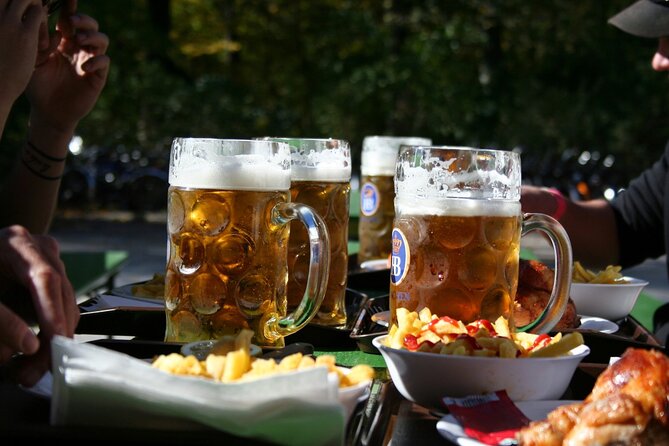
Hofbräuhaus is one of Munich’s best-known beer halls, but on this tour it also appears as a political setting. Hitler delivered one of his early speeches on Nazism there, before the movement held national power.
The point is not that the beer hall itself explains the entire Nazi rise. The useful lesson is that political movements grow in ordinary public spaces, where people gather, eat, drink, and listen to speeches. A familiar Munich landmark takes on a more complicated meaning when you learn what happened there.
You will pedal past Hofbräuhaus rather than sit down for a full meal. If you want to visit inside, return on your own later. That is a sensible arrangement because stopping for a long meal would reduce the number of places covered by the tour.
St-Jakobs-Platz and Munich’s Jewish center
St-Jakobs-Platz represents another important part of the route. It is the Jewish heart of Munich and the site of the city’s new synagogue.
This stop broadens the story beyond Nazi leaders and military monuments. It points toward Munich’s Jewish community and the city’s effort to maintain Jewish life in the center of town. The tour also includes memorials connected with people who resisted the Third Reich, so the focus is not only on persecution and propaganda but also on opposition.
You should expect a respectful outdoor explanation rather than a synagogue interior visit. If Jewish Munich is a major interest, allow extra time later for museums or memorial sites not included in this ride.
How the guides shape the experience
The guide matters a great deal on a tour like this. The history includes names, dates, political groups, propaganda, resistance, and places whose appearance can hide their past. A flat lecture would make the ride tiring.
Simon is described as a doctoral candidate who can explain roughly a thousand years of German history. Jack is praised for being friendly and well informed. Will and Chris are singled out for making the route both educational and enjoyable, with Chris also bringing an upbeat manner to serious material.
That balance is important. You will hear about dictatorship, violence, and resistance, but the entire five hours is not delivered in a grim tone. The guides encourage questions, and you can ask about Munich’s history as you move between stops. The best use of that feature is to ask when a detail confuses you rather than waiting until the end.
Bikes, traffic, weather, and group size
This is an e-bike tour, but you still need to know how to ride and how to follow road signs and signals. One useful warning is simple: green means go and red means stop. That sounds obvious, but it matters when you are riding in an unfamiliar city with a group.
Wear comfortable clothing and shoes. Rain gear is recommended, and sunscreen is a good idea in summer. The pace is described as leisurely, but leisurely does not mean effortless. You will be cycling for much of the day, with regular stops and breaks.
The maximum group size is 14 people. That is small enough for a guide to keep the group together and answer questions, while still large enough to feel like a shared outing. You should remain aware of the group and follow the guide’s directions at crossings and stops.
Most people can participate, but the bike requirement is important. If you have not ridden a bicycle in years, this may not be the right way to see Munich.
Is $93.92 a fair price?
At $93.92 per person, the tour is not the cheapest way to see Munich. You are paying for a guide, bike, helmet, a five-hour route, and the convenience of linking sights that are spread across the city.
The value is strongest if you want two experiences at once: a general introduction to Munich and a serious explanation of the Third Reich. The route includes squares, royal buildings, the English Garden, Hofbräuhaus, Haus der Kunst, resistance-related sites, and St-Jakobs-Platz. Reaching that mix by public transport and on foot would take more planning and likely more time.
The price is less compelling if you already know Munich well, plan to visit only the main historic center, or prefer to spend hours inside museums. Food and drinks are extra, and no hotel transport is included, so add those costs to your planning.
The tour is often booked about a month in advance, with an average lead time of 31 days. That suggests you should not leave it until the last morning of a busy visit, especially if you want a particular date.
Free cancellation is available up to 24 hours before the start time. Cancellations made inside that window are not refunded, and late changes are not accepted.
Who should book this Munich bike tour?
I would recommend it to first-time visitors who want to cover ground quickly without giving up historical detail. It also suits adults and older children who can ride confidently and who want more than a list of postcard sights.
It is a good match for anyone interested in the Third Reich, political history, Jewish Munich, urban design, or the way public places are reused over time. The route also works for a mixed group because the English Garden, Hofbräuhaus, Schwabing, and major squares add variety.
I would think twice if you dislike bicycles, have difficulty riding in city traffic, or want a quiet museum-focused day. The route has outdoor stops, movement, and a fairly serious subject. You should also expect to pay separately for food and drinks at the beer garden.
Should you book it?
Book this tour if you want an efficient, thoughtful introduction to Munich and can comfortably ride a bike for several hours. The strongest reasons are the range of sights, the clear Third Reich focus, the English Garden break, and guides such as Simon, Jack, Will, and Chris who bring energy to difficult material.
Skip it if your priority is indoor museum time or a slow meal-based city tour. For the right person, though, $93.92 buys more than a bike ride. It gives you a connected explanation of Munich, from royal power and artistic life to Nazi propaganda, Jewish renewal, and everyday city life.
FAQ
Where does the tour begin?
The tour begins at Munich Stories, Marienplatz 15, 80331 Munich, Germany.
What time does the tour start?
The scheduled start time is 9:30 a.m.
Where does the tour end?
The tour ends at Mike’s Bike Tours and Rentals near the corner of Hochbrückenstrasse and Bräuhausstraße 10, 80331 Munich. The group finishes at the Discover Bavaria Shop.
How long does the tour last?
The tour lasts approximately five hours.
Are bikes and helmets included?
Yes. The experience includes use of a bike and helmet, along with a professional guide.
Is food included at the beer garden stop?
No. Food and drinks are not included unless specifically stated. You pay for your own snacks and beverages.
How many people can join the tour?
The tour has a maximum group size of 14 people.
Can I cancel for a full refund?
Yes, if you cancel at least 24 hours before the experience start time. Cancellations or changes made less than 24 hours before the start are not refunded or accepted.
More Beer Gardens in Munich
- Private Beer Tasting Tour in Munich with Oktoberfest Museum
★ 4.3 · 3 reviews
More Beer Gardens in Germany
- Munich: Guided City Tour by Bike with Beer Garden Stop
★ 4.7 · 604 reviews - All-inclusive Small Group Beer, Brewery & Oktoberfest Experience!
★ 5.0 · 20 reviews - Private Munich Beer Hall Tour with 3-Course Meal & Beer Tastings
★ 5.0 · 17 reviews - Pub crawl incl. Oktoberfest museum guided tour with beer tasting (private)
★ 5.0 · 5 reviews
Just added around Munich
- Legendary Breweries of Munich: Self-Guided Puzzle Walk★ 4.5 · 7 reviews
- Private Neuschwanstein Castle and Brewery Tour★ 4.0 · 6 reviews
- Self-guided Beer-Tour of Munich: Main Sights, Beer & Breweries★ 5.0 · 4 reviews
- Brewing Through the Ages: A Tour of Munich’s Beer Culture★ 5.0 · 8 reviews
- Munich Beer Tour with a Local Beer Expert★ 5.0 · 2 reviews
- Private Highlights of Munich Bike Tour with Beer Garden Stop★ 5.0 · 3 reviews
- Living Deliberately Today Munich Beer Tours★ 5.0 · 14 reviews
- Private Munich Bike Tour: Flexible Times & Beer Garden Stop★ 5.0 · 15 reviews
Munich Brewery Tours, compared.
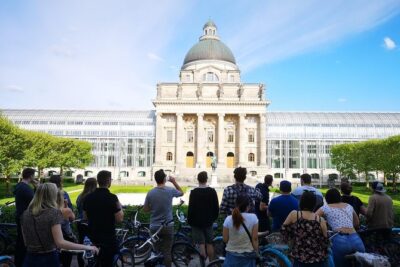
Classic Mike’s Bike Tour daily @ 11.30 incl Beer Garden & Surfers
Read our review →
Munich’s Beer Halls and Breweries: 3-Hour Guided Tour
Read our review →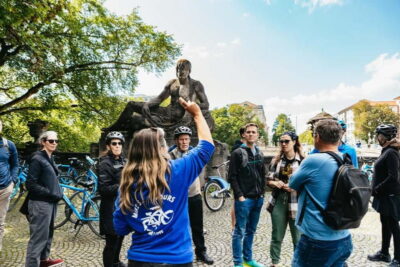
Mini Classic Bike Tour @ 4pm incl. Beer Garden & Surfers 2,5 hrs
Read our review →